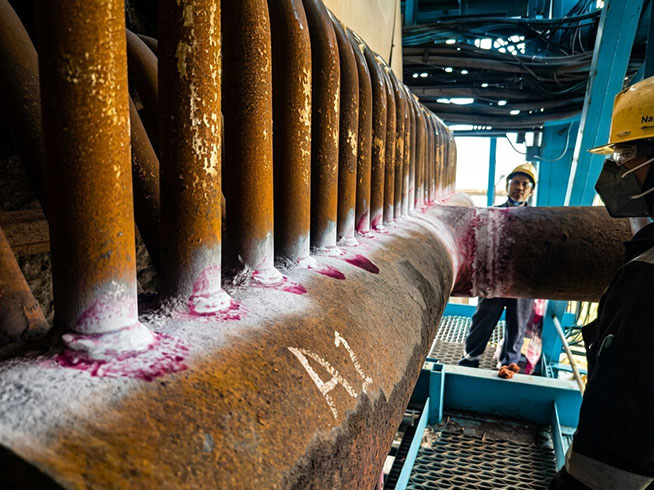
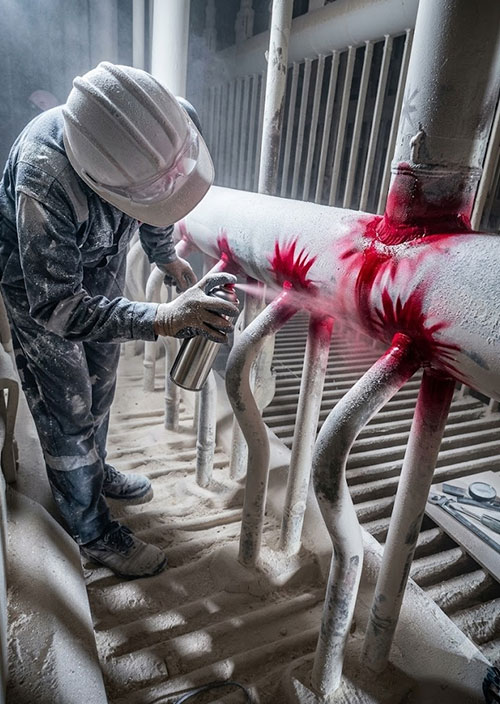
Dye Penetrant Testing (DPT) is a simple and highly sensitive method used to detect surface-breaking cracks and discontinuities. A special penetrant is applied to the component surface - it enters small surface openings and is then drawn back out by a developer, making otherwise difficult-to-see defects clearly visible.
IRC's ASNT Level II and Level III professionals perform DPT for both metallic and suitable non-metallic components.
Why Dye Penetrant Testing
Why Choose Dye Penetrant Testing?
High Sensitivity
Detect very small surface-breaking discontinuities.
Simple Process
A practical inspection method requiring minimal equipment.
Versatile
Suitable for many non-porous metallic and non-metallic materials.
Clear Indications
Defects become visible through colour contrast or fluorescent indications.
How It Works
Our Dye Penetrant Testing Method
01
Surface Cleaning
The component is thoroughly cleaned to remove dirt, oil and contaminants.
02
Penetrant Application
Penetrant is applied across the inspection surface.
03
Dwell & Excess Removal
The penetrant is given time to enter surface discontinuities, then excess penetrant is carefully removed.
04
Developer Application
Developer draws trapped penetrant back to the surface, making defects visible.
05
Inspection & Reporting
Indications are evaluated and inspection results are documented.
Our Toolkit
Our Dye Penetrant Testing Capabilities
Visible Dye Penetrant
Indications are viewed under normal white light.
Fluorescent Penetrant Testing
Uses UV light for enhanced sensitivity.
High-Sensitivity Inspection
Suitable for detecting very fine surface discontinuities.
Qualified Personnel
ASNT Level II & Level III experts for testing and interpretation.
IRC also provides training in Dye Penetrant Testing techniques.
Applications
Applications of Dye Penetrant Testing
01
Welds
Detection of surface cracks and weld discontinuities.
02
Castings & Forgings
Inspection of critical component surfaces.
03
Machinery Components
Detection of cracks in machined parts.
04
Aerospace & Automotive Components
Inspection of suitable non-porous components.
05
Maintenance Inspection
Identification of surface defects before they become critical.