Case Studies
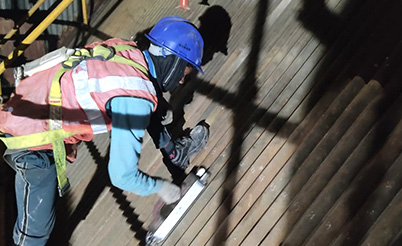
Corrosion Mapping of Six Boilers Using RFET During Overhaul
How IRC mapped water-wall tube condition across 3x200 MW and 3x500 MW boilers at a large thermal power station using Remote Field Electromagnetic Testing.
Background
A large thermal power station operates two stages of boilers: three 200 MW units and three 500 MW units. Water-wall tubes sit in the hottest zone of a boiler, where corrosion and thinning develop over years of service.
The Challenge
During overhaul, the station needed to know the condition of water-wall tubes in all six boilers before deciding on repairs. The overhaul window was limited, and checking tubes one point at a time would not give a complete picture.
IRC’s Solution
In January 2026, IRC was contracted to map the water-wall tubes in the Stage I and Stage II boilers using Remote Field Electromagnetic Testing (RFET). RFET scans along the tube and records wall loss as continuous data, so large areas can be covered during shutdown.
Why RFET Was the Right Choice
- It covers wide tube areas quickly, which suits a tight overhaul schedule.
- It highlights wall loss between spot-check locations.
- It gives the plant a tube-by-tube condition record to plan repairs.
Value Delivered
- Full-area condition data for six boilers across two stages
- A basis for targeted tube replacement instead of broad, unplanned replacement
- A baseline for comparing condition in future overhauls
Mapping the whole tube surface during overhaul tells you where wall loss is, so repairs are planned rather than forced.
FAQ
What does RFET detect?
Wall thinning in boiler tubes, such as corrosion and erosion.
When is it done?
Usually during a planned overhaul or shutdown.
Is it done with UT?
Often. RFET screens, and UT confirms flagged areas.
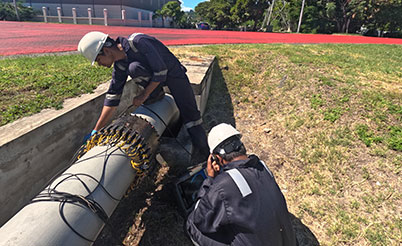
Screening a 17.5 km Gas Pipeline Using Long Range Ultrasonic Testing
How IRC used guided-wave LRUT to inspect a 720 mm x 8 mm gas pipeline stretching 17.5 km for an overseas fertiliser client.
Background
A fertiliser company in Central Asia operates a gas pipeline of 720 mm diameter and 8 mm wall thickness, running 17.5 km. Pipelines this long are rarely checked in full, because most methods inspect only a small spot at a time.
The Challenge
The client needed an integrity check over the whole length. Digging up or scaffolding 17.5 km was not practical, and spot UT readings would leave most of the line unknown.
IRC’s Solution
Under a contract signed in January 2026, IRC deployed Long Range Ultrasonic Testing (LRUT). Guided waves travel along the pipe wall from each test position and reflect from features such as metal loss, so one test position screens a long length of pipe.
Why LRUT Was the Right Choice
- Few access points are needed, so there is little excavation or insulation removal.
- It covers hard-to-reach sections such as supports and crossings.
- It points to where closer inspection is needed, so follow-up is targeted.
Value Delivered
- Full-length screening data for a 17.5 km line
- A shortlist of locations for detailed inspection with UT or other methods
- Reduced excavation and access effort compared with spot checks
On long pipelines, screening first and inspecting in detail only where needed saves time and cost.
FAQ
What can LRUT find?
Metal loss such as corrosion and erosion.
Does it replace UT?
No. It screens, and UT or other methods confirm.
Does range vary?
Yes. Coating, bends and burial all affect how far each test reaches.
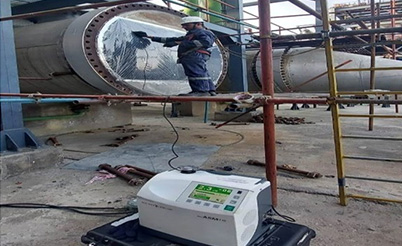
Locating Condenser Air Leaks While Units Are Running
How IRC used online helium leak detection on condenser and vacuum systems across two stages of a thermal power station.
Background
In a steam power plant, the condenser runs under vacuum. Any air drawn in through leaks reduces vacuum, lowers efficiency and raises oxygen in the condensate.
The Challenge
A large thermal power station needed to locate air ingress points in the condenser and associated vacuum systems across Stage I and Stage II units. Searching for leaks by taking units offline would cost generation.
IRC’s Solution
IRC carried out online helium leak detection in 2025–26. Helium tracer gas is applied to suspect areas while the unit runs, and a detector picks it up at the point where air is being drawn into the vacuum system.
Why Online Helium Testing Was the Right Choice
- It finds the exact leak location, so repairs are targeted.
- It does not require shutting the unit down.
- It can be repeated after repair to check the fix.
Value Delivered
- A list of confirmed leak points for maintenance planning
- Testing done without taking units off load
- A repeatable method for later checks
A condenser leak can be located precisely while the unit runs, so there is no need to stop generation just to search.
FAQ
Why is condenser air ingress a problem?
It reduces vacuum and efficiency.
Where else is helium testing used?
Air-cooled condensers, generators, heat exchangers and vessels.
Can it be done online?
Yes, for vacuum-side areas of a running unit.
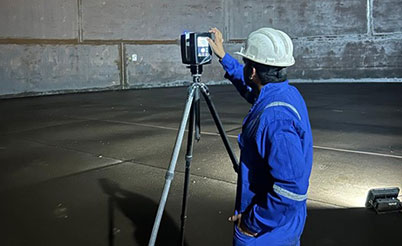
Laser Scanning of a Large Storage Tank as per API 653
How IRC used 3D laser scanning to inspect a 36 m diameter, 15 m high storage tank at an oil terminal.
Background
Large atmospheric storage tanks change shape over time because of settlement, loading and age. API 653 inspection checks that the tank remains fit for service.
The Challenge
A 36 m diameter x 15 m high tank at an oil terminal needed dimensional inspection. Taking measurements manually across such a large surface is slow, and it gives only a limited number of points.
IRC’s Solution
In 2025–26, IRC carried out laser scanning and inspection of the tank. A 3D laser scanner records the whole surface as a dense set of points, which can then be used to check shape, verticality and settlement.
Why Laser Scanning Was the Right Choice
- It captures the entire tank surface, not just selected points.
- It reduces the time inspectors spend on the tank.
- It creates a digital record to compare against future scans.
Value Delivered
- A complete geometric record of the tank
- Data to support API 653 assessment
- A baseline for future inspections
Scanning the whole tank gives a fuller picture than spot measurements, and the record stays useful for later inspections.
FAQ
What does it measure?
Shape, roundness, verticality and settlement.
Do people need to enter the tank?
Scanning of the outside surface does not require entry.
Which standard is followed?
API 653 for in-service storage tanks.
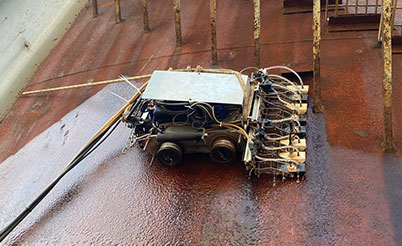
Robotic Thickness Mapping of Acid Storage Tanks
How IRC used robotic crawlers to map shell plate thickness in acid storage and clarifier tanks at a fertiliser plant.
Background
Acid storage and clarifier tanks work in aggressive conditions, and the shell plates thin unevenly. Manual access is difficult and hazardous.
The Challenge
A fertiliser plant in eastern India needed thickness data across the shell plates of several tanks. A few spot readings could miss the thinnest areas, and manual access meant exposure to hazardous conditions.
IRC’s Solution
IRC used a robotic crawler fitted with ultrasonic thickness measurement. The crawler moves over the shell surface, so inspectors do not need to climb or work at height. IRC has carried out this work for the plant in 2022, 2024 and 2025.
Why a Robotic Crawler Was the Right Choice
- It reduces manual climbing and exposure to hazards.
- It maps thickness across plates instead of a few points.
- It produces comparable data from one year to the next.
Value Delivered
- Plate-by-plate thickness maps for each tank
- Year-to-year data that supports corrosion rate tracking
- A safer working method for inspectors
Repeat orders across three years show the plant values trend data from the same method.
FAQ
What does the crawler measure?
Wall thickness of shell plates by ultrasonic testing.
Why repeat it?
Comparing yearly maps shows how fast corrosion is progressing.
Can it be used on other equipment?
Yes. IRC has also used robotic crawlers on kiln shells and boiler tubes.
Whether you need a one-time inspection or a long-term integrity programme, our team is ready to help.