Tube Inspection Services
What Is It
One Failed Tube Can Shut Down a Heat Exchanger
IRC Engineering inspects boiler and heat exchanger tubes from the inside, using the right combination of Eddy Current, RFET, IRIS, and MFL technology for each tube material and condition.
Boiler and heat exchanger tubes face continuous thermal and pressure stress. A single undetected flaw - wall thinning, pitting, or a developing crack - can cause a tube rupture and take down an entire unit.
Because tubes are inspected from the inside, purpose-built techniques are used to assess their condition without removing them from the bundle.
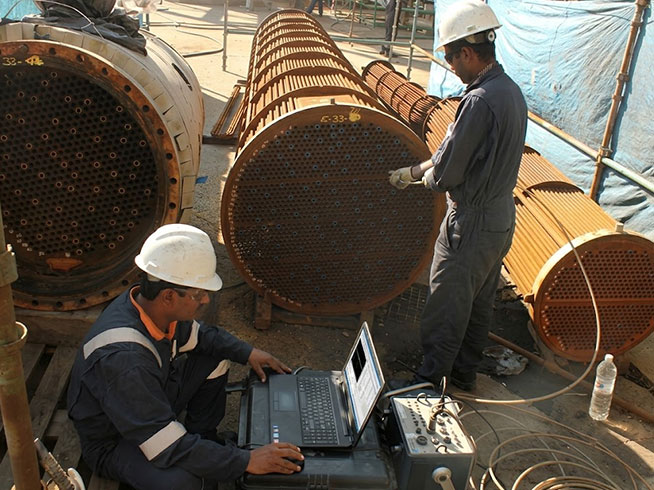
Our tube-inspection service supports:
- Boiler tubes
- Heat exchanger tubes
- Brass, copper-nickel, and stainless-steel tubes
- Carbon-steel and other ferromagnetic tubes
- Tube bundles requiring condition assessment
Why Inspect
Why Tube Inspection Can’t Wait for a Failure
Prevent Unplanned Shutdowns
Detect degradation before an in-service tube rupture occurs.
Targeted Maintenance
Identify the exact tubes that need plugging, repair, or replacement.
Extend Service Life
Catch wall loss, pitting, and cracking early to support safe continued operation.
Better Outage Planning
Use quantified, tube-by-tube condition data for maintenance planning.
How It Works
Our Tube Inspection Method
We select the right inspection technique - or combination of techniques - based on tube material, wall thickness, and dimensions.
Tube Assessment
Review the tube material, condition, wall thickness, and dimensions.
Eddy Current Testing (ECT)
For non-ferromagnetic tubes such as brass, copper-nickel, and stainless steel; detects pitting and wall loss.
Remote Field Eddy Current Testing (RFET)
For ferromagnetic tubes; detects internal and external wall loss with similar sensitivity.
Internal Rotary Inspection System (IRIS)
An ultrasonic method that provides precise, quantifiable circumferential wall-loss measurements.
Magnetic Flux Leakage (MFL)
A fast screening method that reveals metal-loss areas across large tube counts.
Our Toolkit
Our Tube Inspection Technologies
Eddy Current Testing (ECT)
Detects pitting and wall loss in non-ferromagnetic tubes.
Remote Field Eddy Current Testing (RFET)
Detects internal and external wall loss in ferromagnetic tubes.
Internal Rotary Inspection System (IRIS)
Provides precise wall-thickness and wall-loss measurements.
Magnetic Flux Leakage (MFL)
Provides fast screening for metal loss across large tube counts.
Using the right technology for each tube gives a more complete picture of tube condition.
Where We Apply It
Applications of Tube Inspection
Boiler Tubes
Inspect tubes exposed to continuous thermal and pressure stress.
Heat Exchanger Tubes
Identify tube defects before they affect exchanger operation.
Non-Ferromagnetic Tubes
Inspect brass, copper-nickel, and stainless-steel tubes using ECT.
Ferromagnetic Tubes
Assess carbon-steel tubing using RFET.
Tube Bundles
Generate tube-by-tube condition data for maintenance decisions.
Know exactly which tubes need attention before the next outage.
Why IRC
Why IRC Engineering Services?
Since 1995
Inspecting critical tube assets for boiler and heat-exchanger applications.
Right Technique Selection
Technology selected according to tube material, wall thickness, and dimensions.
Combined Inspection Methods
Techniques can be used in combination for a more complete assessment.
Internal Inspection
Assess tube condition from the inside without removing it from the bundle.
Quantified Condition Data
Clear condition information to support repair, replacement, and outage planning.
We would love to connect with you, please fill out this form and our dedicated team will respond to you shortly.